
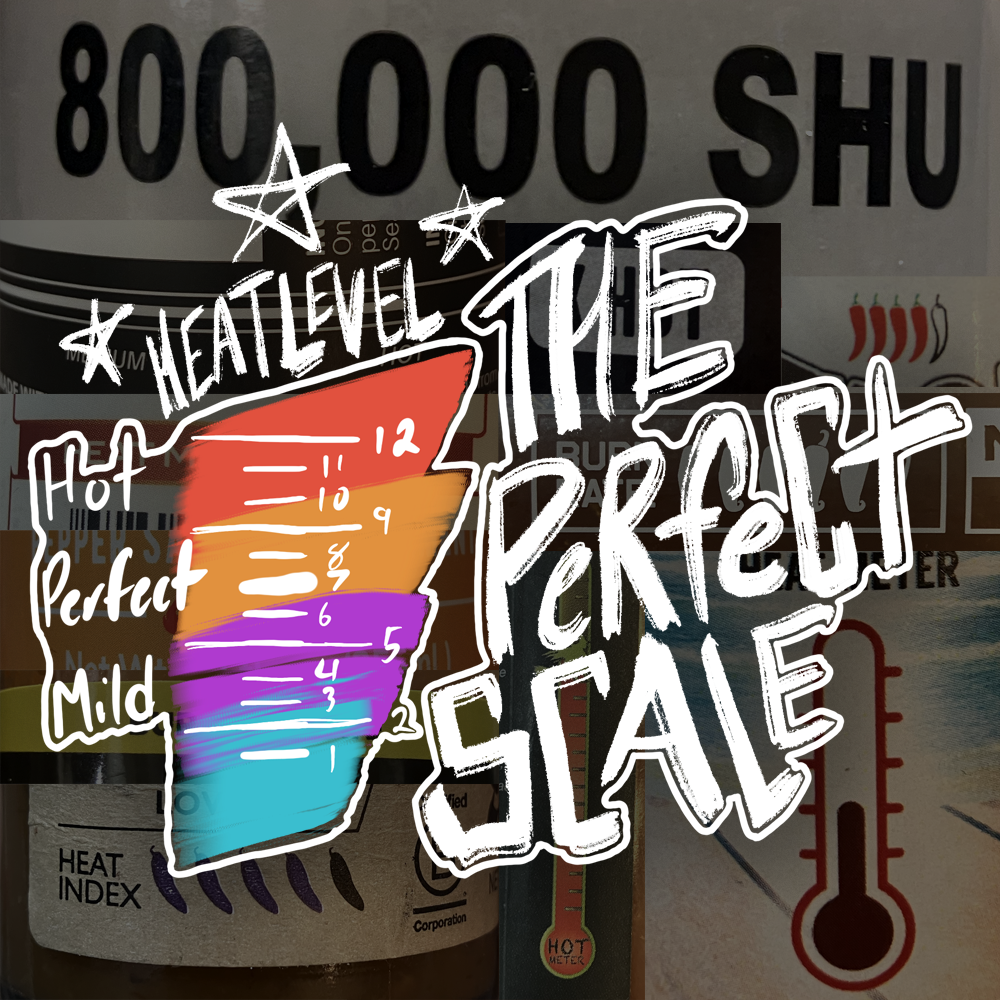
I’m tired of the lack of consistency for hot sauce/food spiciness scales (and don’t even come at me with that Scoville crap). I’m done, I made my own scale and everyone should use it.
Too many damn scales

Look at the bottle or website of your favourite hot sauce and you’re bound to see at least some variation of the mess above. You got 5-point scales, 6-point scales, 10-point scales, 12-point scales, thermometers, mild/medium/hot scales, and of course the mother of all scales: Scoville. They are all trying to tell us how much hurt these sauces will inflict without any consistency, standard, or accuracy. I applaud their effort, but it’s time for something better.
Scoville is meaningless
Well, what about Scoville? On the surface it seems like the best scale and is as close to an objective standard as we can get. True, but it has it’s problems too:
- It’s not human. The range goes from 0 to (as of today) 2,693,000. What does that mean? Is 400,000 hot? who knows.
- It’s not feasible. Most sauces don’t have a Scoville rating because it’s not easy to calculate.
- Perception varies. Take for example DA’BOMB Beyond Insanity. This sauce has a measly Scoville rating of 135,600. I can tell you that anyone who has ever tried that sauce knows it feels a helluva lot hotter than that.
The new standard (Dzamage)
I designed my scale for how humans consume hot sauce. The result is a 12 point scale that answers the question:
How would it feel to the average person to consume a standard dinner-sized plate (10-12″) of food (evenly distributed approximately 1″ thick) with a moderate drizzle of hot sauce applied.
There are a couple exceptions to this rule:
- If the sauce is prepared for a specific use case (such as chicken wings), the test would instead be for that specific use case in a restaurant-sized serving. So in the case of a wing sauce, the test would instead be for 100% coverage of 8 standard sized wings.
- If the test is not sauce related, but rather a feature of a dish or drink, the test would instead be for full consumption of a restaurant-sized serving of that dish or drink.
Wait a sec, what’s a moderate drizzle?
I knew you would ask, so here’s a detailed diagram:

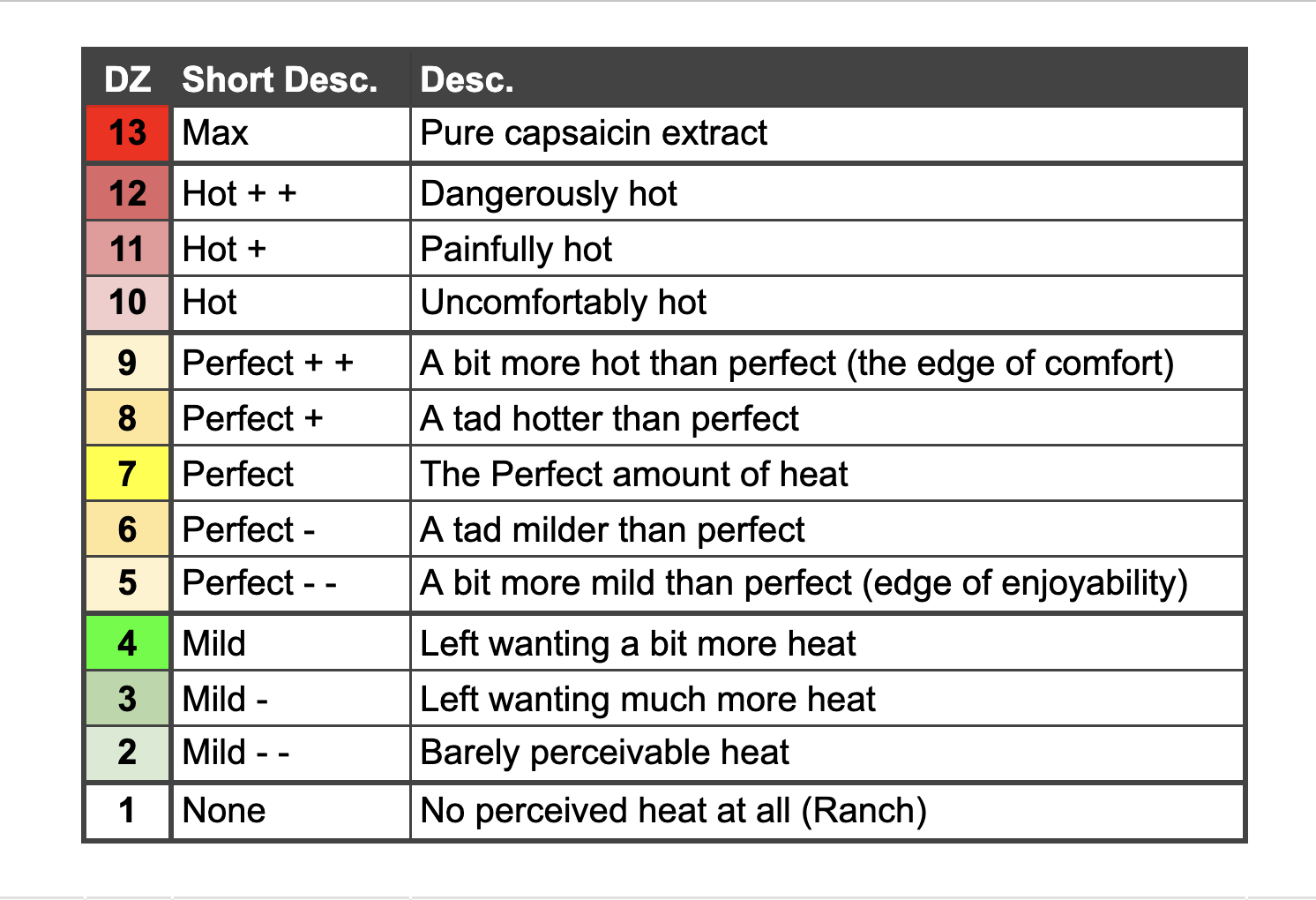
Now that we have the parameters sorted out, here’s how the scores are distributed:
The Dzamage Scale (DZ)
1 DZ
1. No perceived heat at all. For example Ranch salad dressing is a 1.
2 – 4 DZ (Mild)
The mild range is assigned 3 values:
2. Barely perceivable heat
3. Left wanting much more heat
4. Left wanting a bit more heat
5 – 9 DZ (Goldilocks)
I’ve given the most range to the Goldilocks zone, because variety is the spice of life (pun intended). Some dishes you want a bit spicier than you would normally, some you want a bit milder.
5. A bit more mild than perfect (edge of enjoyability)
6. A tad milder than perfect
7. The Perfect amount of heat
8. A tad hotter than perfect
9. A bit more hot than perfect (the edge of comfort)
10 – 12 DZ (Hot)
Much like the mild range, the hot range is given 3 values:
10. Uncomfortably hot
11. Painfully hot
12. Dangerously hot
13 DZ
13 Dzamage (which isn’t an official value) is reserved for one thing and one thing only, pure capsaicin extract and nothing else.
Feel free to use this scale
In fact, I encourage it’s usage. Put it on your bottle, website, whatever. If you want, link back here so that people know what it means. I dream of a world with a consistent standard for spicy: consistant, human-friendly, and easy to determine.